
• We've upgraded and reskinned the forum. Notice something off? Email us at [email protected] and we'll fix it.

V1 Refrigerant HE Cooling

kano501

Member
kano501
I've been lurking the forums for some time now as I searched for my donor car. I've finally obtained a '07 SS/SC and making kit purchase very soon.

I am planning to eventually do some road coursing and on my hunt for information, I've noticed seen many mention heat soaking and cooling issues. While I do see ducting has been added for the Goblin kit's HE, I don't necessarily want to duct under the car because I'd like to have a flat bottom for some aero with a diffuser.

One thing I came across from reading how other platforms have battled heat on a SC setup is Dodge a couple aftermarket companies have tapped into the car's HVAC to add a secondary HE cooling system.

Killer Chiller

Active Interchiller

These are two companies I've linked and have found that are somewhat active.

Now, my question to the community and maybe to those who are tracking a SS/SC Goblin, how are your IAT2s after a (~15-20min) session and how are you currently managing?

These system seem to more cater to a drag racing crowd but given we don't use A/C in these cars anyway, it would be a good alternative. Or even run one of their standalone systems that run off of an electric 12v compressor that runs at full efficiency at all times. I would run this in conjunction with either the kit supplied HE or an aftermarket like ZZP's.

Looking forward to getting my build started next month with stripping my donor and getting more involved with the community. :D

pics for clicks of donor. She ain't much but it has a good running motor and trans!
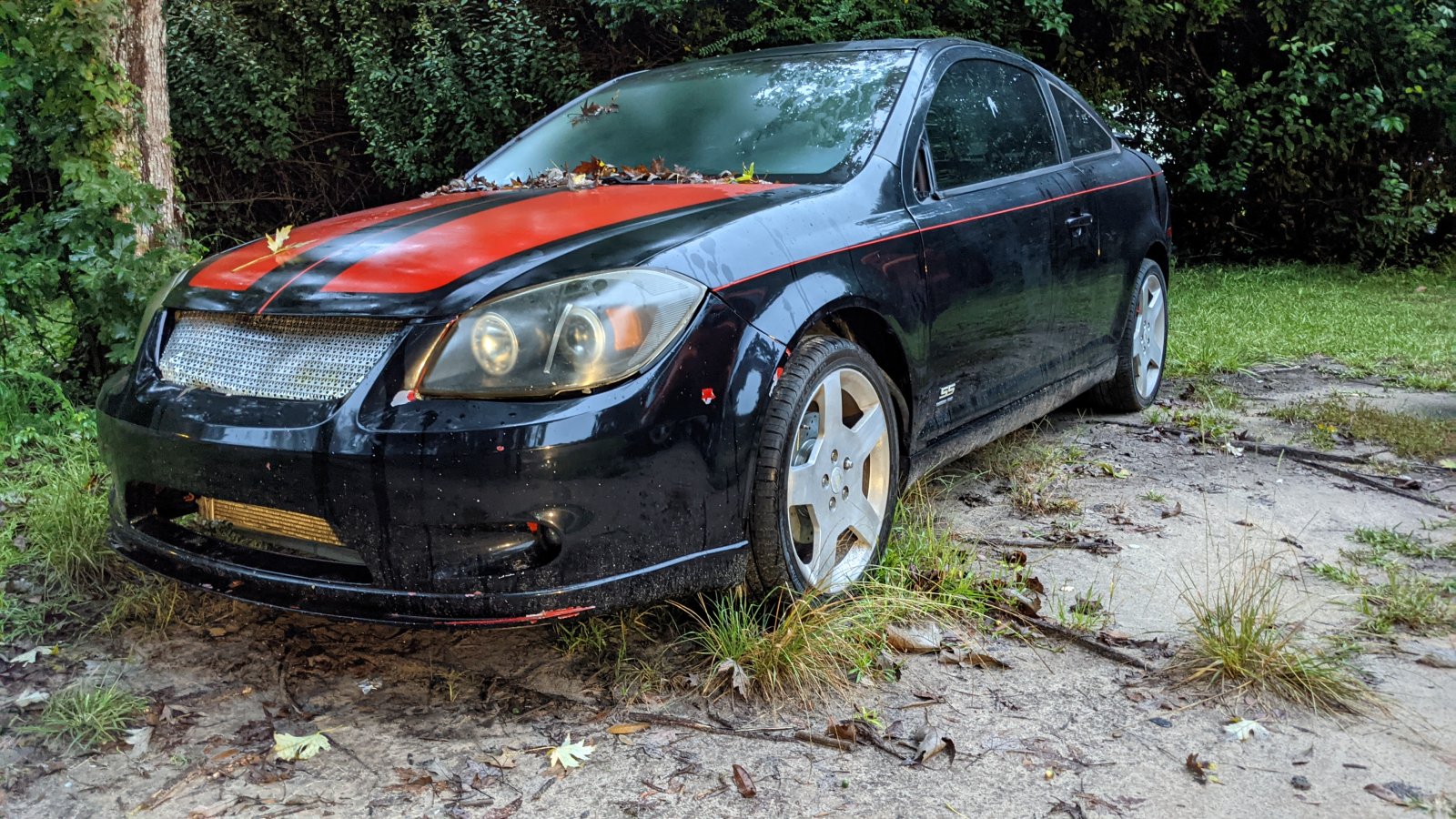
29257
 
Ross
Why not just run an ice box water reservoir like the drag race cars do?
It would be less complicated than a second battery on an AC system.
From what I have read, the interchillers aren't worth the effort. The AC system is taking power to chill the air to make power. You now have the complication of an AC pump, AC134, evaporator, etc, and it uses about the same amount of power that it makes.

By the way, my Chevy laminova tube intercooler with the DF chiller work well for the stock 12PSI boost. People making 20+PSI boost don't find that this system can keep up. Need a bigger intercooler and/or chiller.
 
Rauq
I thought about it. One of the biggest drivers of my consideration is that there's not a straightforward way to entirely eliminate the AC compressor on an LSJ due to belt routing. I gutted my compressor (actually following Ross's advice, if I recall correctly).

I'm sure it's not worth it for drag racing. Like Ross said, you're better off with an ice box. For track days, I can't say. It probably boils down to how much power you're using to drive the compressor vs how much power you make with the cooler air. The stock system disengages the compressor clutch above a certain throttle percentage which I think is adjustable in the tune but not entirely defeatable, so I'm not sure how much benefit there is to be had on a track anyway. There's also an argument to be made for the safety of the motor with high IATs, but I'll touch on that in a different way.

The supplied heat exchanger is probably adequate for most SS/SC builds. Some folks have added another or a bigger heat exchanger, but at a point, the limitation becomes how much heat the laminova cores in the intercooler can pull out. You could run an endless supply of cold water through them and they can only lower IATs so much. A dual pass endplate helps, but the root issue remains. If you're in that territory, in my opinion, you're asking too much of the supercharger anyway. The design of the M62 blower is such that it becomes inefficient beyond certain pressure ratios. In the end, if you're going to try to run a 2.6" pulley and spin the engine to 8,000 RPMs without a ported head and cams and E85 and all that, sub-ambient intercooler temps probably aren't going to make that big of a difference anyway.
 
G
All of the mentions I have seen of the "AC" coolant system on the Camaro forum is that they are useful/recommended for drag racing but not road racing. I'm not sure why.
 
95Blitz
You can completely remove the A/C pump..
 

Attachments

  • 20210602_173326_HDR.jpg
    20210602_173326_HDR.jpg
    288.1 KB · Views: 373
  • 20210602_173344_HDR.jpg
    20210602_173344_HDR.jpg
    322.5 KB · Views: 356
kano501
Why not just run an ice box water reservoir like the drag race cars do?
It would be less complicated than a second battery on an AC system.
From what I have read, the interchillers aren't worth the effort. The AC system is taking power to chill the air to make power. You now have the complication of an AC pump, AC134, evaporator, etc, and it uses about the same amount of power that it makes.

By the way, my Chevy laminova tube intercooler with the DF chiller work well for the stock 12PSI boost. People making 20+PSI boost don't find that this system can keep up. Need a bigger intercooler and/or chiller.

While I don't plan to be pushing high boost I will have a 3.0 or 2.9 pulley at best to avoid the high IAT2s. along with E85

The idea is just to combat heat as much as possible. I've read extensively into it and the parasitic loss isn't as much as most would think. The stock ECU start pulling timing somewhere in the range of 100* IAT2 from what I've read (pretty typical for most car ECUs). In the summers these temperatures can be well north of 130*s and on a 15-20min session on a track would definitely introduce heat soak. I've read the laminova cores only have so much capacity but every bit helps I suppose. I did intend to run in conjunction with a traditional HE. As far as complication, it wouldn't be nearly as bad because I'm using only on a switch. no temperature control or fan blower level. Just simple on while engine is running.

I believe one the companies also offers a stand alone, low power draw compressor if I chose not to use the stock compressor. This may be an even simpler alternative.

I thought about it. One of the biggest drivers of my consideration is that there's not a straightforward way to entirely eliminate the AC compressor on an LSJ due to belt routing. I gutted my compressor (actually following Ross's advice, if I recall correctly).

I'm sure it's not worth it for drag racing. Like Ross said, you're better off with an ice box. For track days, I can't say. It probably boils down to how much power you're using to drive the compressor vs how much power you make with the cooler air. The stock system disengages the compressor clutch above a certain throttle percentage which I think is adjustable in the tune but not entirely defeatable, so I'm not sure how much benefit there is to be had on a track anyway. There's also an argument to be made for the safety of the motor with high IATs, but I'll touch on that in a different way.

The supplied heat exchanger is probably adequate for most SS/SC builds. Some folks have added another or a bigger heat exchanger, but at a point, the limitation becomes how much heat the laminova cores in the intercooler can pull out. You could run an endless supply of cold water through them and they can only lower IATs so much. A dual pass endplate helps, but the root issue remains. If you're in that territory, in my opinion, you're asking too much of the supercharger anyway. The design of the M62 blower is such that it becomes inefficient beyond certain pressure ratios. In the end, if you're going to try to run a 2.6" pulley and spin the engine to 8,000 RPMs without a ported head and cams and E85 and all that, sub-ambient intercooler temps probably aren't going to make that big of a difference anyway.

E85 is definitely an option I'll be looking into along with porting the charger and manifold and SC spacers. I'll probably incorporate some sort of ducting into that area just to get air flow around the manifold as well. There are ways to trick the AC system to stay on via switch to keep compressor running under load. As mentioned before, the parasitic draw isn't as bad as most may think. If anything, it would just be more wear on the compressor itself from the high RPM speeds.

All of the mentions I have seen of the "AC" coolant system on the Camaro forum is that they are useful/recommended for drag racing but not road racing. I'm not sure why.

Mostly because of recovery time and making the system run constantly versus shutting off at WOT which most will do to save the life of the compressor. A switch or a stand alone system would alleviate it. If a 15* or more gain can be made to lower IATs I'd say it would be worth it. Well, I'm no expert so I should say I hope. :p

You can completely remove the A/C pump..

I have read this but I was more looking at the option of keeping it and utilizing it to my advantage.
 
Desert Sasqwatch
Dr. GOOGLE sites are quoting 5 to 20 HP to run the A/C pump, depending upon make, model and who is answering. But running the A/C also requires a heat exchanger with a fan that will also pull HP with the alternator under load, which robs another 5 to 10 HP - for the same reasons above. So best case is 10 HP, worst case is 30 HP. 10 or more HP on a 300 HP engine is a much higher percentage than say the system used in a Hellcat with 800 HP. Not sure if the tradeoff in reduced IAT is worth the HP expenditure to use the A/C to cool the intake.
 
kano501
Dr. GOOGLE sites are quoting 5 to 20 HP to run the A/C pump, depending upon make, model and who is answering. But running the A/C also requires a heat exchanger with a fan that will also pull HP with the alternator under load, which robs another 5 to 10 HP - for the same reasons above. So best case is 10 HP, worst case is 30 HP. 10 or more HP on a 300 HP engine is a much higher percentage than say the system used in a Hellcat with 800 HP. Not sure if the tradeoff in reduced IAT is worth the HP expenditure to use the A/C to cool the intake.

You have a valid point for sure. I think the load to run the fan is a bit on the high side but that is another topic on it's own. Still, I get your point.

On a different argument, it would be for sake of avoiding heat soak and detonation while on track. Wondering if E85 would be my ultimate solution to avoid this then...
 
G
Remember that just the fact that it’s pulling some timing isn’t a bad thing in itself. As it gets warmer the combustion happens faster so it just doesn’t need the same timing. I know at some point the heat is a problem but I don’t know that 100 degrees is it.
 
kano501
Remember that just the fact that it’s pulling some timing isn’t a bad thing in itself. As it gets warmer the combustion happens faster so it just doesn’t need the same timing. I know at some point the heat is a problem but I don’t know that 100 degrees is it.

Right, my (little) understanding is that around 100* is when the ECU begins to pull timing. 150*+ is when it can be dangerous according to a few posts I've seen on the HPT forums.
 
Desert Sasqwatch
Out here in the desert it is possible to have 120 degrees or more ambient air temps (not that I would be out hammering on my Goblin when it's that hot). Add in some boost and and even a small amount of heat soak and very high IATs are a reality we have to deal with. An oversized intercooler and dual heat exchangers with cooling fans and water spray are implemented to help fight the temps, but can only go so far at 120 degrees. Next solution is water/meth injection to provide inside-the-intake cooling to drop the IAT below ambient temperature and raise the apparent fuel octane to help keep the engine from pulling timing. Just wanted to share the challenge we have in the hottest location for a Goblin - outside of driving in Death Valley. :cool:
 
ATMironov
I reached out to FI Interchillers not to long ago to discuss a road racing application.
The main problem is volume of cold water that can be stored. They recommended a 5 gallon storage tank and to run the interchiller in series with an Air to Water intercooler.
Also, the AC compressor disengages at high RPM, so it would need to be under driven.

Here is their response:

The AC compressor cannot do engine RPM.
In addition, if you did underdrive the compressor to then be at a normal speed it's a case of try it and see we don't know your heat load vs cooling capacity so we do not know what temperature it will level out at.

Under normal circumstances (drag racing/daily driving/mile racing) we are cooling a volume of fluid down and then relying on the volume of fluid to see us through the period of wide open throttle.

For circuit racing what we do suggest is:
Run a 5gal tank combined with the chiller
Retain a front mounted water to air heat exchanger on a temperature controlled bypass valve.

When the fluid temp is 70f as example the fluid will split 50/50 heat exchanger and interchiller.
When the fluid temp is under 70f the fluid will be 100% interchiller, see below image.

9390727F-3EE0-425B-A8C3-F7E17B080D24.jpeg
 
Waterdriver
Is it worth all the extra weight you'll be carrying by adding a chiller? Plus the added complexity.
The added cooling benefit that you get in a Goblin is, that the engine isn't confined behind a hot radiator and enclosed in a hot box (engine compartment). So heatsoak is less of an issue.
Running a second heatexchanger, both with fans, plumbed in parallel to each other will do you well.
 
Tinkles
From my experience with SC Ecotecs, the actual heat exchanger system is more of a recovery system. IATs will still climb to 130*,150*,170* in boost but the better your heat exchanger system is, the quicker it will drop once you stop making boost. I would personally put my effort into porting the intake manifold, head, etc. Give it more room for air so it won't be compressed as much. And see what chemical cooling you can run. Even just water injection should work better than an interchiller. I have seen E85 work wonders on roots supercharged V8s with carbs. I doubt that it will be as effective with fuel injection, but does still look to be one of the best options.

I forget my actual IAT numbers but swapping out the stock M62 supercharger for a Harrop HTV1320-LSJ supercharger will lower IATs. It will run lower IATs if you stay at the same power level.

My plan for controlling IATs in my Goblin is:
Dual Mishimoto Kawaski KFX700 radiators for heat exchangers(one mounted on each side in front of the rear wheels in their own custom scoops/pods).
Ported LSJ intake manifold converted to single pass(coolant enters drivers side and exits passenger side). Talking with SS/SC cobalt guys it is just about the only coolant mode to the intake manifold that actually makes a difference.
Flow through coolant reservoir that holds at least 1 gallon.
"Upgraded" ZZP heat exchanger pump.
Intake manifold to cylinder heat phenolic spacer.
Harrop HTV1320-LSJ supercharger. But I will be running small pulleys so it probably doesn't count.
Ignite E90 fuel.
Amsoil coolant with their water "enhancer" additive. No idea if it will actually do anything, but I still need to fill the system with something so why not.

I would love to cut out the laminova cores/tubes of a LSJ intake manifold and replace it with an actual water to air brick heat exchanger. But that is something that quite far down the road ATM.
 
Rttoys
I have been looking into Kawi kx250f rads to put inside the frame somewhere, with their own electric fans. It’s on my list to do before May, when it starts getting hot.
 
Back
Top