
• We've upgraded and reskinned the forum. Notice something off? Email us at [email protected] and we'll fix it.

V1 Strange Idle Issue

Rauq
Red to fused switched power, black to ground, white goes to the AC pressure signal wire, you're correct. What I tied my red wire into is not going to be relevant to you, unfortunately.

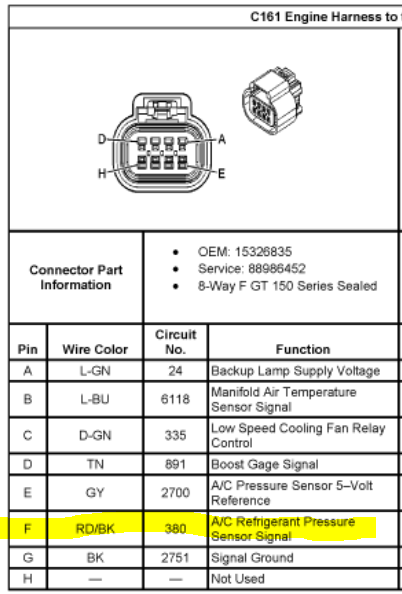
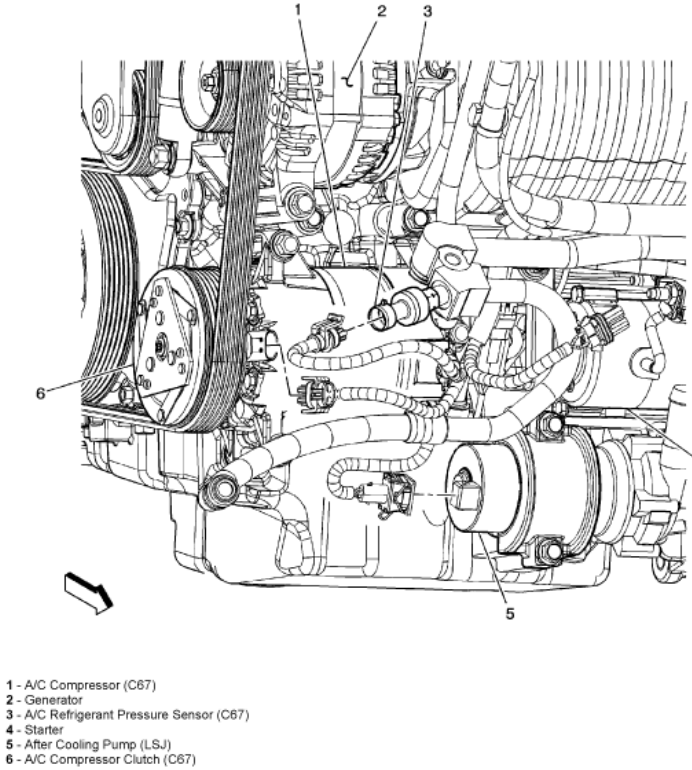
On my '06 LSJ the AC pressure signal wire is the red and black wire in position F on the engine harness to body harness connector, C161. For what it's worth, that wire is orange and black between the other side of the C161 connector and pin 26 on the C1 connector on the PCM. If your wire is red and black and in position F, that's probably the right one, but there's no guarantees with GM wiring. And no, that wire didn't originally go to the AC compressor, but to the refrigerant pressure sensor pictured below.

The rest of the wires, yes, you can isolate, tape, wrap, and disregard.
41912

41913
 
F
Red to fused switched power, black to ground, white goes to the AC pressure signal wire, you're correct. What I tied my red wire into is not going to be relevant to you, unfortunately.

On my '06 LSJ the AC pressure signal wire is the red and black wire in position F on the engine harness to body harness connector, C161. For what it's worth, that wire is orange and black between the other side of the C161 connector and pin 26 on the C1 connector on the PCM. If your wire is red and black and in position F, that's probably the right one, but there's no guarantees with GM wiring. And no, that wire didn't originally go to the AC compressor, but to the refrigerant pressure sensor pictured below.

The rest of the wires, yes, you can isolate, tape, wrap, and disregard.
View attachment 41912
View attachment 41913
Oh thats perfect - I left that little connector for the refrigerant sensor intact, so I'll just snip it and run a lead to that wire. For the keyed power, could I just splice into the radiator fan wire or intercooler fan wire?
 
G
If the Heater for the o2 sensor is fed by this circuit, you might want to add relay or at least make sure it's protected after the splice with a smaller fuse. You don't want a shorted heater circuit to take out a coolant fan and cause the car to overheat. If the heater isn't on the circuit, you still need a smaller fuse, otherwise a short might burnout the feed wire from the splice to the gauge before the fan fuse will blow.
 
F
If the Heater for the o2 sensor is fed by this circuit, you might want to add relay or at least make sure it's protected after the splice with a smaller fuse. You don't want a shorted heater circuit to take out a coolant fan and cause the car to overheat. If the heater isn't on the circuit, you still need a smaller fuse, otherwise a short might burnout the feed wire from the splice to the gauge before the fan fuse will blow.
So I just traced the radiator fan wire, which appears to go to a 30A relay. The power actually travels from the supply, through the gauge/controller and then to the sensor. Are you saying to insert an inline fuse between the splice point into the fan wire, and the gauge?
 
Sluggonaut
Red to fused switched power, black to ground, white goes to the AC pressure signal wire, you're correct. What I tied my red wire into is not going to be relevant to you, unfortunately.

On my '06 LSJ the AC pressure signal wire is the red and black wire in position F on the engine harness to body harness connector, C161. For what it's worth, that wire is orange and black between the other side of the C161 connector and pin 26 on the C1 connector on the PCM. If your wire is red and black and in position F, that's probably the right one, but there's no guarantees with GM wiring. And no, that wire didn't originally go to the AC compressor, but to the refrigerant pressure sensor pictured below.

I can confirm the wires on my '07 LSJ were the same color.

I used the key-on power wire that was bundled up during the wiring harness work.
 
Rauq
The red (maybe pinkish) one that powers the intercooler fan?
That's actually the wire that I used, which I previously considered was irrelevant, as I didn't use the intercooler fan wire that was wired to the front of the car. Both my A2W HX and A2A fans are in the rear and powered off their own relay.

Generally speaking, solid pink wires throughout the car are switched power, and solired wires are battery power.
 
G
So I just traced the radiator fan wire, which appears to go to a 30A relay. The power actually travels from the supply, through the gauge/controller and then to the sensor. Are you saying to insert an inline fuse between the splice point into the fan wire, and the gauge?
I would have to check the wiring diagram to see exactly how the fan is wired. My point was based upon your considering using them, not that it would actually work without checking the diagram. Mostly just saying to do it right, it's not as simple as grab any hot wire and connect it.
 
F
So I went ahead and just kinda jank wired it for the purposes of getting a reading but going to re-wire it properly once this issue is fully resolved.
It is reading between 27 and 29. Most of the time hovering around 28. Is that what we want?
 
Desert Sasqwatch
There should be a O2 heater circuit already in the Cobalt fusebox/ harness that will handle the up to 30A of current needed for the O2 heater. Would highly recommend locating it in the wiring schematics and wire in the O2 properly to avoid potential burned up wires or damage to whatever circuit you are tapping into - other than the O2 heater.
 
G
Or just the initial reading on the wideband gauge prior to startup. Or millivolts on HPT log? or....? You really need to supply more details in your post for us to be able to help.
 
G
I just checked the manual for an AEM 30-0334 and 30-0310 (I don't think you have told us what you are using). It looks like the o2 heater is ran off of the gauge and can be ran off of a 5a fuse. Remember you need to size your fusing not just for the load but to protect your wiring.

If you have "jank" connections on the output side of the gauge, you won't have good readings.
 
F
Apologies for the lack of detail previously - I'll do my best to be more specific here.

Wideband is an AEM 30-0300

So I suppose jank was not really the best word - more so temporary. I just pulled power from the constant hot red/white striped wire labeled "accessory power (amp)" - I don't have a shop and it is supposed to rain for the next week straight so just trying to get a reading so that I can at least determine if the air to fuel ratio is the issue. I know this will kill the battery, so I just disconnected the sensor and ground after I was finished with it.

When I mentioned "It is reading between 27 and 29. Most of the time hovering around 28" I was referring to the initial reading off of the wideband.

I took another scan with HPT and also recorded a video (linked below). During the scan, I let it idle, pushed it to WOT, let it idle more, cut it, then restarted and let it idle again. I have not figured out how to get the channel for the wideband added into HPT yet.

@Rauq when you say:
"Then, I take my butt over to HP Tuners, add the AC Pressure Sensor channel and Commanded AFR to my logs, set up Math Parameters for Wideband AFR and AFR error (and gripe about LSJ's in HP Tuners wanting to do AFR in gasoline numbers instead of Lambda)." --- I got the first bit where you add the AC pressure sensor channel, but what do you mean when you say "Commanded AFR to my logs, set up Math Parameters for Wideband AFR and AFR error"?

For the most part, the misfire on idle seems to be gone (having turned down the fuel pressure), except for when it comes down from WOT and also after I restarted the engine. So I believe the idle is resolved (but please advise otherwise if you disagree, after looking at the tune). The main issue now seems to be cold starts. -- Turn the engine over, then it lights up and dies. Repeat 10-15 times until it finally stays lit. My guess here is that fuel pressure diminishes over night as the car sits and then the pump does not run long enough to fully prime the fuel rail upon initial start.

Video here:
 

Attachments

G
Have you changed the injector settings as you have changed pressures? Injector settings are for particular pressures.

You have to take the AC pressure reading that is a 1-5 volt signal from the HPT channels and use a math function to convert it to either AFR or Lambda depending on which one you want to tune with. The math formula is in the 03-300 manual. I just dug into it a little further and it shows the white and brown wire used for the 0-5v output signal. Did you use the brown?
 
F
Have you changed the injector settings as you have changed pressures? Injector settings are for particular pressures.

I have not. I'm assuming this has to be done in the tune? If so, this is still something I have yet to learn. My knowledge of HPT is pretty limited at this point, but getting better. Al at ZZP wrote my tune.

You have to take the AC pressure reading that is a 1-5 volt signal from the HPT channels and use a math function to convert it to either AFR or Lambda depending on which one you want to tune with. The math formula is in the 03-300 manual. I just dug into it a little further and it shows the white and brown wire used for the 0-5v output signal. Did you use the brown?

I used the white, but I also have not even gotten to the point of actually adding into HPT yet - it started pouring while I was out there so I had to pack it in unfortunately.
 
Rauq
edit: just watched the video, I didn't even realize that a wideband could read 29. I'd assume that was a fluke, but --- is maxing out the sensor's capability to read lean mixtures. I'd be looking for a mad vacuum leak. I'm impressed it's still running. I don't think it's going to hurt anything idling like that, but dang, that's lean. Like half the it fuel should have... assuming Al got your tune set up for the right injectors, are you sure you actually have the right injectors? Can you grab a part number off one of them?

Is the wideband reading 27/28 at the gauge or in HP Tuners? I can't imagine what you could do to get the gauge to read those numbers, even if it were set to Lambda. If that's the case... phew, I'd have to back to the install to figure that out.

If you're talking about HP Tuners reading 27 or 28... I can go back through the HP Tuners setup.
 
Last edited:
F
Is the wideband reading 27/28 at the gauge or in HP Tuners? I can't imagine what you could do to get the gauge to read those numbers, even if it were set to Lambda. If that's the case... phew, I'd have to back to the install to figure that out.

If you're talking about HP Tuners reading 27 or 28... I can go back through the HP Tuners setup.
Uhoh...That is indeed at the gauge. Did you happen to see the video? Sometimes it would go as low as high 26's and sometimes as high as 29-30
 
Back
Top